• Home
  • About
  • Contact
  • Blog
  • A Relaxing Stroll Through the Book of Revelation
Menu

Rob Carmack

  • Home
  • About
  • Contact
  • Blog
  • A Relaxing Stroll Through the Book of Revelation

How Receiving Criticism Can Make Us Better

November 3, 2014

This post is Part 4 in an ongoing series about preaching, public speaking, and standup comedy. Part 1.  Part 2.  Part 3. 

* * *

Before I started Collective Church, every church I ever regularly preached in used Comment Cards in their services. These are cards that are given to every person in the room and are collected during the offering at the end of the service. Most churches use this system primarily to gather prayer requests, but people are invited to offer any feedback they like on the cards. So, with the Comment Cards, any person in the church can write a positive or negative comment and submit it to be read by the entire church staff.

Comedians have hecklers. Preachers have Comment Cards.

Every time I ever preached at a church that used Comment Cards, I would receive at least a handful of complimentary remarks via the cards. I always appreciated the kind words and positive feedback—in fact, there were some weeks that my entire sense of self-worth came from them.

Of course, all of the comments were not positive. Not every time, but at least 75% of the times when I would preach, I would receive at least one or two negative comments on the cards.

One negative comment I received several years ago said this:

“Why does Rob wear such grungy jeans? Casual is great. Dirty, not so much.”

I feel like I should point out that this comment came through on a weekend in which I was particularly proud of the sermon. It was my first Sunday to preach after my daughter was born. I even showed an adorable newborn picture of her, just to butter up the crowd. I had people laughing in all the right places, and I passed out string cheese. I still look back at that sermon as one of my favorites. Feeling like you did a great job is a pretty rare thing, so I was trying to savor it a little bit.

And then I read the comment about my jeans.

True story: I read that comment and then went right out and bought two new pairs of jeans and saved them to wear exclusively on Sunday mornings.

As annoyed as I was that the only thing the commenter found memorable about the entire service was what I was wearing, I realized that she was probably right. In fact, my wife had said something very similar to me only a week earlier. “You’re a grown man,” she had said. “You can afford to buy new pants every once in a while.” Message received.

Sometimes our critics are right.

Sometimes I need to give my ego a little time-out and choose to learn from the people who say negative things about my work.

I wish all of the negative comments I’ve ever received were as innocuous as “Rob needs new jeans.”

During my first year as a teaching pastor at one church, I preached four weeks in a row during the summertime, and there was one woman in the church who wrote something negative every single week that I spoke. One of  her comments read-            

“When is [senior pastor] or [other teaching pastor] going to preach again?”

The next week, she sharpened the blade a bit and wrote this-

“Was there a message? We feel Carmack jumps from one idea to another with no connection to each other.”

Ouch.

I should also point out that, for some insane reason, that church’s Connection Cards offer a rating system. This enables people to give the various service elements a numerical rating from 1 to 5 (“1” being terrible and “5” being awesome). On the first week’s comment cards, the woman who left all the negative comments rated the music a 4 and the sermon a 1. So as part of her vendetta against me, this woman also wrote about how much she loved the music and hated my preaching, continuing to give me 1’s every week. Throughout my time at that church, this woman consistently wrote on her Comment Cards about how much she disliked me.

There is nothing I can do about this kind of criticism. Like I said in Part 3 of this series, I will never make everybody like me. Some people will criticize you just because they don’t like your style, which feels pretty close to not liking you.

That said, there are times when we receive criticism, and our critics are right. When the commenter said that I needed to buy new jeans, she was correct, and I responded to that bit of feedback by fixing the problem.

So here’s what we need to do-

Listen to Your Critics

By far, the most common criticism I have received about my preaching is that I talk too fast. This is a perfectly valid critique, and I have spent years working on my pacing and trying not to race the clock with my words. In fact, if you were to go back and listen to some of my sermons from five or six years ago and then listen to one of my sermons from the past few months, you might notice that I have slowed down quite a bit. It’s still something I’m working on, though. Every time I preach, I think about how fast I am talking.

Another bit of feedback I have received has been related to my body language and hand gestures. I used to wander around the stage aimlessly, wasting lots of energy by walking in circles or flapping my arms for no apparent reason. I had no idea I was doing this until someone pointed this out. I watched a few videos of myself preaching, and I realized that the person was absolutely right. I needed to be more aware of my own body while I was speaking.

If you spend any time speaking in public, I’m sure you have your own list of quirks and habits that tend to hold you back from delivering at the highest possible quality. The trick is to know yourself well enough to understand what needs to be fixed. Always work toward making the next sermon (or speech or presentation or whatever) better than the one before.

This is a habit that standup comedians, as a group, have developed. They scrutinize every minute aspect of their onstage presentation, and they work toward getting better every time they hold a microphone.

Some people get very defensive about their work, and they do not respond well to constructive criticism. They don’t want to know that they talk too fast or that their body language is weird. They only want to be told how great they are. They don’t want to get better because they want to believe that they are already as good as they can possibly be.

Sometimes our critics are trying to make us better at what we do.

Not always, of course. There will always be the critics who are mean-spirited or simply don’t like you because they prefer something else.

We need to learn to discern between helpful criticism and cruel criticism. If a piece of criticism seems designed only to make you feel bad about yourself—not just your work, but yourself—feel free to disregard and keep working on your craft. However, if a piece of criticism—while possibly painful to hear—contains something helpful or true, pay attention to it. Use it, and get better.

What bits of feedback seem to come back to you over and over again? Perhaps someone is trying to help you improve your art.

If you don’t know how you can work to improve, just ask someone close to you. They already know.

Comment

"On Earth as it is in Heaven" (Lord's Prayer, Part 3)

October 30, 2014

This post is Part 3 in an ongoing series on Jesus' prayer in Matthew 6 (a.k.a., "The Lord's Prayer"). Part 1.  Part 2.  

* * *

I recently saw someone on Facebook post the trailer for the new Left Behind movie and wrote, “Pay attention, people! This is going to happen one day!”

What she means, of course, is that she believes that one day all of the true believing Christians will mysteriously disappear and leave this earth to burn at the hands of lowly sinners.

This is reflective of what a lot of people call “Evacuation Theology,” which basically talks about the earth as a place that we need to get away from as fast as possible. In this view, heaven is a good place, and the earth is a bad place.

Here’s the problem with that: Jesus never talks about the earth as a place we need to escape from. Instead, when Jesus prays in Matthew 6, he says (to God), “Your kingdom come, your will be done on earth as it is in heaven” (Matthew 6:10).

Jesus does not pray, “Get us off of this crazy thing and take us to heaven as fast as possible.” Instead, he prays that earth would become more like heaven.

In the ancient world, most people possessed a three-tiered view of reality: There was earth (where humans live), there were “the heavens” (where the gods lived; this was generally thought to be up in the sky), and “below the earth” (where the dead existed). And in the Hebrew mind, each realm was ruled by a particular force. The heavens—or “heaven”—was governed by the will of God. All things in heaven are as God intended them to be. Earth, on the other hand, was governed by many “wills.”

One Hebrew poet says it this way-

“The highest heavens belong to the Lord, but the earth he has given to mankind” (Psalm 115:16, emphasis mine).

So the realm that is governed by God has one kingdom; the realm that is governed by humans has billions of kingdoms.

If I want something that somebody else has and I decide to go to war in order to get that thing, I am pitting my kingdom against someone else’s. Two kingdoms are coming into conflict with one another.

Every single conflict in the history of humanity can be traced back to a tension between multiple kingdoms.

But when Jesus prays, he prays that God’s kingdom would come on earth as it already has in heaven.

Jesus is praying that earth would become more like heaven.

So we have all of these people who keep talking about all of the humans getting out of here and going up to heaven, which is somewhere else. But at the same time, we have Jesus praying to God that heaven would come down into this realm and that the world we inhabit would look more like God intended it to be.

What is Jesus praying for?

He is praying that each of us would help make this world look more like God intended it to be.

The psalmist says that God has given the earth to humanity. Perhaps Jesus is praying that humanity would give it back.

Perhaps this is what it means to be part of a redemptive movement: We are in the process of making this world more and more as it was always meant to be.

Read Part 4

Tags The Lord's Prayer
Comment
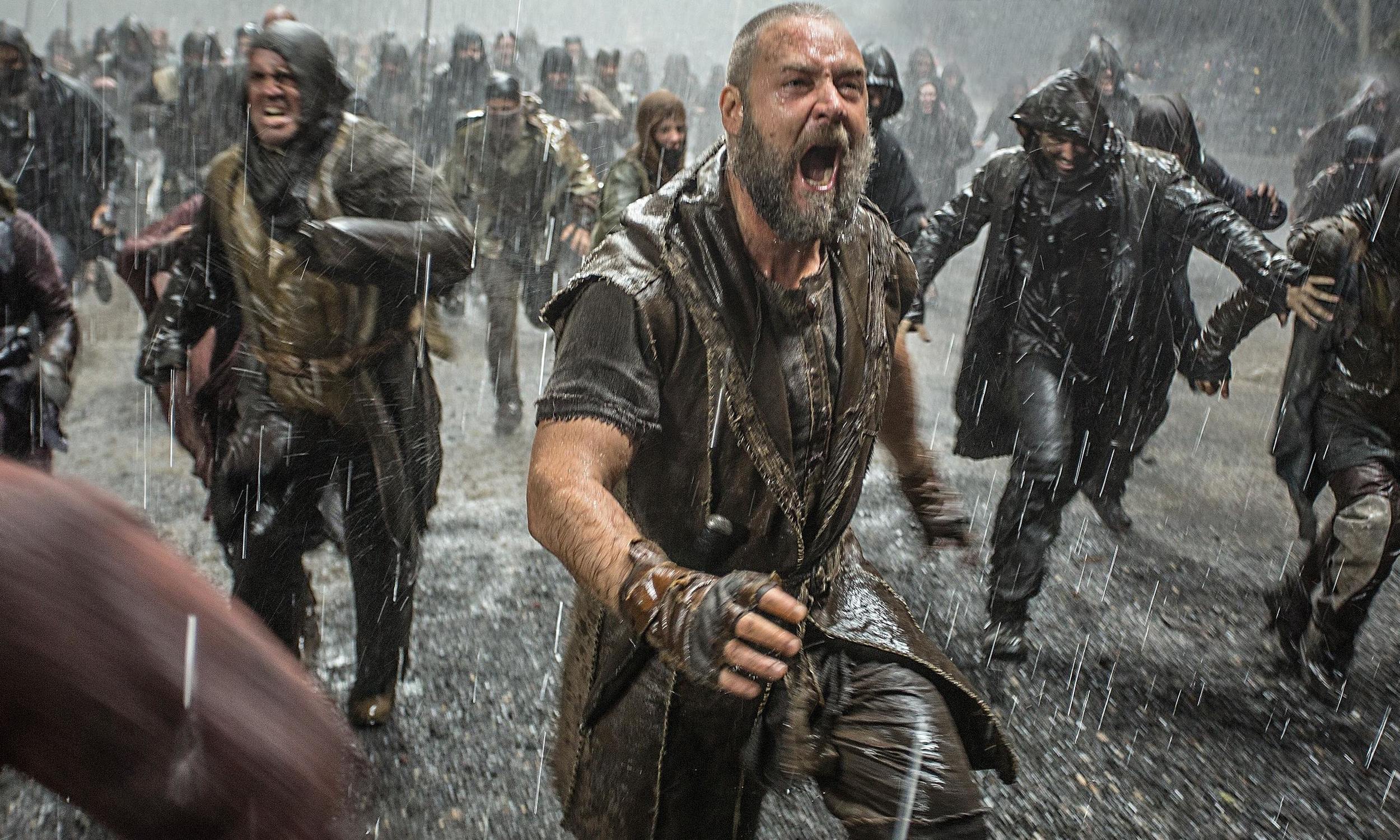
PHOTO: PARAMOUNT PICTURES

PHOTO: PARAMOUNT PICTURES

Ancient Magic, Glowing Snakeskin, & Secret Stowaways: Q&A on Darren Aronofsky's NOAH (Part 2)

October 27, 2014

This is the second part of a two-part discussion regarding the 2014 Darren Aronofsky film NOAH starring Russell Crowe.  Click here for Part 1 OR Click here to download the entire discussion in PDF form.

* * *

There seems to be a lot of fantastical stuff in this movie. A forest grows from a single seed, Methuselah seems to have some kind of pregnancy power in his hands, and Noah’s dad has a glowing snakeskin. Doesn’t this take away from the believability of the story?

I’m not sure how believable people were expecting this story to be in the first place. In the world of pre-flood Genesis, you have talking snakes and people who lived for hundreds and hundreds of years. Even the biblical portions of the Noah story are pretty fantastical—animals flock to his giant boat in pairs, and Noah and his family are able to cohabitate on said boat with said animals without being mauled to death by a jungle cat. So if you are already accepting the flood narrative to begin with, I don’t think it’s too far outside the realm of possibility that there were other magical or fantastical elements that are not talked about in the story.

Again, this is Midrash, which means it is an attempt to build out the world even more fully with more stories in order to help us understand the larger themes of the original narrative, and the things that are added are meant to contribute to the theme, not some sort of historical account.


In the Bible, it says that each of Noah’s sons had wives,[1] but in the film they don’t. This seems like an overt betrayal of the original text.

To be perfectly honest, this was initially my biggest problem with the film. In fact, Aronofsky even fakes us out by making us believe Ham’s potential wife will jump onboard the ark at the last minute, but Noah callously abandons the girl to be trampled to death just before the deluge begins. I kept waiting for the inevitable introduction of Ham and Japheth’s wives, but it never happened. And once the ark’s doors were shut and it was clear the wives would not be appearing in this film, I was seriously taken aback. This seemed like an unnecessary detail to leave out.

However, by the end of the film, I had forgiven Aronofsky for the oversight because I realized he had made this choice very intentionally as a way of getting at a larger theme.

For the purposes of the film, Ham needs to feel like an outsider. One of the things (in the film) that separates Ham from his older brother Shem is that Shem has love in his life in the form of a girl named Ila,[2] played by Emma Watson, which has launched a handful of speculative questions regarding whether or not this movie is a Harry Potter prequel. In contrast to Shem, Ham has no one, and he feels the weight of that isolation even before he becomes one of the only people left on the planet (Noah’s youngest son, Japheth, mostly seems like an afterthought, and I’m not sure how much he is meant to play into the themes here). Much of the film’s narrative tension relies on Ham’s personal journey. So to remove the presence of Ham’s wife may be contrary to the biblical source material, but it works for the purposes of the story here.


There are several overt images of serpents and snakeskin throughout the film, and it seems like the skin of the snake is supposed to be a good thing. However, in the book of Genesis, the first mention of a serpent is when humanity is tempted to sin against God. So what’s the deal with the snakeskin?

There is a common assumption that serpents always represent Satan—that they are evil incarnate, which is a sentiment that I tend to share whenever I see one in my driveway. However, it may be helpful to remember that a) snakes were part of the original Creation in Genesis 1 and 2, and that same whole Creation was declared “good” by God,[3] and b) the book of Genesis never actually says that Satan was the snake. It merely says that the snake was “crafty.” So the symbolism itself is a little more nuanced than “snakes are bad.”[4]

Aronofsky’s co-screenwriter Ari Handel was interviewed in Relevant Magazine and was asked several questions about this film’s theology. At one point, the interviewer specifically asks about the snakeskin motif, and Handel gives a really interesting answer-

When Adam and Eve are expelled from the Garden, it says God gave them a garment of skin—sort of a parting gift from God to mankind as we leave Eden and go out into the world. So we wondered what that was—and as we looked at commentaries about it, one of the common ones was that it was the skin of the snake. We wondered why that would be, and it occurred to us that God made the snake. The snake was good, at first. But then, the Tempter arose through it. In our version, we have the snake shed that skin, and the shed skin is the shell of original goodness that the snake left behind when it became the Tempter. It’s a symbol of the Eden that we left behind. It’s a garment to clothe you spiritually.[5]

So of course, the hero of the film carries the light-colored shed skin of the serpent—the metaphor of humanity’s original goodness. When Noah’s father wants to pass down his birthright to his son, he is about to give him the snakeskin when they are rudely interrupted and Noah’s father is murdered.

Notice also that in the CGI snake scenes, the snake’s color changes from light to dark. The filmmakers are using the snake as a recurring metaphor about humanity. They seem to be saying, We began as something good, but we devolved into something evil. We shed our light skin and only dark remained. Redemption comes to those who remain connected to the light.

And did you notice what Tubal-Cain is eating while he hides in the belly of the ark? A dark-colored snake. The character who most represents human depravity in this film is seen consuming the metaphor that was set up as a symbol of human depravity.


I’m glad you brought that up. This movie has a stowaway on the ark! I’m pretty sure that isn’t in the Bible.

Tubal-Cain’s presence on the ark is a metaphor. There are several places early in the book of Genesis where characters essentially are given a choice between two paths—the two trees in the Garden of Eden,[6] the choice to offer worthy sacrifices or not,[7] the choice to kill or to preserve life,[8] etc. In order for Ham to experience a moral dilemma consistent with the tone and themes of Genesis, he needed to be faced with two plausible paths—the path of his father and the darker path of Tubal-Cain.

I think it’s also worth noting that Tubal-Cain has a valid point-of-view. He is not a mustache-twisting straw man villain who seems to be evil merely for the sake of having a villain in the movie. He feels abandoned by God, and he feels entitled to make his own way in the world, even if that way is guided by violence.

What’s great about how the movie is written is that, when I was watching it for the first time, I had no idea what Ham was going to do. At the end of the Genesis story, Noah is at odds with Ham, so it made sense that the filmmakers might create a situation where their conflict began here—Noah killing Tubal-Cain and denouncing Ham as his son at this point rather than later in the narrative after Noah wakes up with a hangover.

Of course, this doesn’t happen. Ham chooses his father’s path, and they are reconciled. Ham still feels like an outsider, but he is a hopeful outsider.


In the movie, Noah seems kind of insane. He doesn’t seem interested in human life, and he even wants to murder his own grandchildren. This doesn’t seem very consistent with the biblical descriptions of Noah as “good” and “righteous.”

This was actually one of my favorite parts of the movie. Think about it: if you are truly a good person, and you learn that you and your family will be the only survivors of a global catastrophe, wouldn’t that be a little difficult to cope with? If you are good and your heart is tuned to the heart of this God who is grieved over the brokenness of the world, wouldn’t that take a heavy psychological toll?

Most Sunday school images of Noah make him look like a cheerful, care-free grandfatherly-type—basically Santa Claus with a giant boat. He’s always smiling and waving and praying. So yeah, if that’s what you were expecting you might have preferred they cast Tim Allen as Noah.[9] This Noah seems a lot more likely to start an Emo band and get a tattoo of a crying dolphin on his ankle.

Let’s also keep in mind that we tend to read the word “good” and attach our own understandings and expectations to that word. What would be described as “good” by one person might be described as “barely tolerable” to another. It might be helpful to remember that the actual description of Noah in the book of Genesis is that he was “a righteous man, blameless among the people of his time, Noah walked faithfully with God.”[10] So first of all, the part where Noah is described as “blameless among the people of his time” is often interpreted by some rabbis to mean that he was only good compared to everybody else at the time, which apparently was not necessarily a high bar to clear. In Jewish tradition, Noah is neither a hero nor a saint—he is merely a survivor.[11] It wasn’t until Christians began telling this story to their children that Noah became a bright, shiny hero in the minds of the story’s hearers.

Let’s move on to the second clause of that verse, which states that Noah “walked faithfully with God.” To “walk faithfully with God” is to be attuned to the way God sees reality. How does the beginning of this story claim that God sees reality? God is grieved—brokenhearted over what has become of this once-beautiful creation. So if Noah shares this point-of-view, that grief—along with everything that follows—might just be enough to drive a person mad.

Also, let’s remember that the people in the Bible who are described as walking closely with God are often those who are most frequently tormented in their own souls. Jacob wrestles with God all night long.[12] Joseph’s heart is metaphorically ripped out of his chest when he is reunited with his brothers.[13] Moses verbally argued with God at least once or twice.[14] Even Jesus sweats blood when he prays just before he is arrested.[15] So why do we expect Noah to be all glassy-eyed and simple-minded? Let’s at least allow for the possibility that a person who truly was righteous and close to God might have had a few sleepless nights over watching the whole world drown to death.


I’ve heard some people say that Noah is overly concerned with environmental themes. I even read one blogger who called this whole movie “a giant environmental propaganda piece.” Is this environmentalism part of the original text, or is this a sign that the writers and director have attached their own political agenda to this story?

There is no question that environmentalism is one of the dominant themes of this film, and director Darren Aronofsky has not been ambiguous about his desire to see humanity become more responsible toward the earth’s natural resources. So yes, it’s certainly in the film. But that’s not really the question here, is it? The real question is “Does the Genesis story support this interpretation?”

In Genesis 1, God creates all things—things on the ground, things in the sky, and things in the water—and declares all of these things to be “good.” Humanity then is instructed to interact with creation in a healthy, sustainable way.[16] So environmentalism is already built into the book of Genesis from the very first chapter.

The story of Noah does contain environmentalist elements. God not only spares Noah and his family—the animals are spared as well. The first sign of good news while the survivors are stuck inside the ark is a piece of fresh vegetation brought by a dove. When Noah is able to live on the ground again, the very first thing he does is plant something—a vineyard. Noah himself is described as a “man of the soil.”[17] It is also worth noting that, until God’s covenant with Noah in Genesis 9:3, people had never been given permission to eat meat. In Genesis 2, God specifically gives plants for humans to eat, but not animals.[18] So the imagery of villainous people killing animals at the beginning of the film is consistent with the context of the Scriptures—people were not supposed to do that. So even if this seems heavy-handed and preachy, it is completely consistent with the biblical narrative.

* * *

Footnotes:

[1] Genesis 7:13

[2] According to Aronofsky and his co-screenwriter Ari Handel, they named the character after their college roommate’s daughter. The word “Ila” in Hebrew means “light.” This information and more can be found in Peter Chattaway’s interview with Handel and Aronofsky at http://www.patheos.com/blogs/filmchat/2014/03/the-jewish-roots-of-and-responses-to-noah.html

[3] The claim that all created things are good recurs throughout the entire first chapter of Genesis.

[4] It’s probably worth noting that snakes aren’t always bad in the Bible. One counter-example of snakes and evil is when Moses’ staff turns into a snake when he comes before the Pharaoh in Exodus 7.

[5] Tyler Huckabee. Relevant Magazine. “Noah’s Co-Writer Explains the Film’s Controversial Theology.” April 4, 2014.

[6] Genesis 2

[7] Genesis 4:6-7

[8] The rest of Genesis 4

[9] Or Steve Carrell, as was the case in the far-less-controversial film Evan Almighty, which also was an adaptation of the Noah story, and contained far more biblical inaccuracies.

[10] Genesis 6:9

[11] Rabbi Shmuley Boteach explains this point-of-view from a Jewish perspective in the article “Hollywood ‘Noah’ is kosher, says celebrity rabbi” by Jordan Hoffman in the Times of Israel (March 27, 2014)

[12] Genesis 28

[13] Genesis 45

[14] Exodus 32

[15] Luke 22

[16] Genesis 1:28

[17] Genesis 9:20

[18] Genesis 2:8-9

Comment
PHOTO: PARAMOUNT PICTURES

PHOTO: PARAMOUNT PICTURES

Biblical Accuracy & Rock Monsters: Q&A on Darren Aronofsky's NOAH (Part 1)

October 26, 2014

In my early drafts of Lost in the Flood, I included an Appendix in which I addressed many of the major questions people had raised regarding Darren Aronofsky's film NOAH. The film was released earlier this year and was met with mixed reviews. Many of the film's harshest critics claimed that Aronofsky had not been faithful to the biblical source material. Lots of people wanted to talk about the movie and various themes and elements found within it. I had originally planned to make this part of my book, but it simply didn't fit the book's tone and structure, so it had to go. However, I still feel like there are lots of things to discuss about the movie. So I wanted to make this available to anyone who was interested. It's pretty lengthy, so I'll break it up into two parts to make it easier to navigate. This is Part 1. You can also download the entire document here.

* * *

Lots of people are frustrated by this movie because it does not line up with the Bible’s narrative and even sometimes directly contradicts what the Bible says. How are we supposed to respond to a movie that does not take the Bible seriously?

I don’t know that I agree that the film and its makers aren’t taking the Bible seriously. They have certainly taken some creative liberties with specific details in the story, but that doesn’t mean they aren’t taking the source material seriously. Like any film based on a previously existing work, this movie is an adaptation, not a beat-for-beat re-creation of Genesis 6-9. And, as far as adaptations go, this is actually a pretty good one.

In an adaptation, some things need to be changed to serve the new medium. For example, I mentioned in chapter 5 chapter that—outside of the final scene—Genesis doesn’t give Noah any dialogue. So the very minute a screenwriter puts any words in Noah’s mouth it becomes a little bit less rooted in the source material. They also took a bit of license in casting Russell Crowe to play the title character. At the time of filming, Crowe was in his late forties. He’s a fairly versatile actor, but it would have been far more biblically accurate to hire an actor who was at least 580 years old, since the Bible claims that Noah was 600 when the floods came. And let’s not even mention the fact that the movie is spoken in English, which did not exist as a language until at least the 5th Century AD, thousands of years after the biblical account of Noah first appeared.

See what I mean? Every choice made by every filmmaker when working with a previously existing story is an act of creative license. I mean, Mel Gibson had a scene in The Passion of the Christ where Jesus invents the table, and nobody cried foul over that. I’m no archaeologist, but I think it’s very possible that did not really happen.

So as we move forward in our conversation, it will be helpful to remember that we are dealing with an adaptation—someone’s interpretive retelling of the story for cinematic purposes. Film critic Alissa Wilkinson writes this in her Christianity Today review of the film:

[Noah] does what good art should do: it forces us to "re-see" a story anew, to once again sit on the edge of our seats and wonder what will happen next. That's hard to do with such a familiar story, and this is done well, while still respecting and hewing to its source material, as well as it can.[1]

In order to help us “re-see a story anew,” a filmmaker needs to tell the story in a new way, which requires some form of creativity and adaptation.


Fair enough. I understand that the filmmakers needed to take certain liberties with the story in order to tell it to their audience. Obviously Noah couldn’t actually be cast as a 600 year-old man, and it would have been pretty challenging to recreate the entire film in Hebrew as it is written in Genesis, so I’ll give you those points. But what about where the film seems to intentionally deviate from the biblical account? It seems like Aronofsky went out of his way to change parts of the story. What’s up with that?

I can’t disagree that there are places in the movie that pose direct contradictions to the book of Genesis. The lack of wives for two of Noah’s three sons in particular struck me as odd, especially since Ham’s lack of a wife became such a major plot point in the film. That’s just one example. I suppose we’d have to confront each issue specifically in order to really figure out what’s going on here. Where do you want to start?


Let’s start by talking about The Watchers. You know, the giant rock monsters that help Noah build the ark? That was pretty weird.

 This always seems to be one of the first things people want to talk about, probably because it is so striking and memorable. You bought a ticket to a movie about a Bible story you’ve heard a hundred times, and within thirty minutes of the movie’s opening shot, you have these giant, boulder-like creatures that look like prehistoric Hasbro Transformers. All over the world, people were leaving movie theaters and asking each other, “Where did those rock monsters come from?”

This may surprise you, but the presence of The Watchers in the film actually shows how much research Aronofsky and his team did while preparing to make this movie. First of all, there is that portion in Genesis 6 that talks about the Nephilim, which (as previously discussed in chapter 2) nobody really knows what that might have looked like. The film describes these creatures as fallen angels, which means their presence in this story is completely consistent with the Bible. Of course, the book of Genesis does not describe the creatures as rock-like or have them helping Noah build the ark. However, it’s much more complicated than the question of whether or not the filmmakers simply made this part up.

In the Bible, there actually is mention of creatures called “the Watchers.” It shows up in the book of Daniel. Take a look-

In the vision of my mind in bed, I looked and saw a holy Watcher coming down from heaven.[2]

And then a few verses later-

This sentence is decreed by the Watchers; This verdict is commanded by the Holy Ones…[3]

In the footnotes of the JPS Jewish Study Bible, the interpreters explore this phrase-

Watcher, an angelic figure, common in Jewish apocalyptic literature, who executes God’s justice. In some texts watchers are fallen angels.[4]

The filmmakers were not going way off the rails by calling these creatures “Watchers” instead of Nephilim, since there is already a biblical precedent for exactly this language. However, Darren Aronofsky later admitted that he wishes he would have called them the Nephilim.[5]

If you dig into the tradition a little deeper, it gets crazier. There is a book called 1 Enoch that is not accepted as canonical,[6] but it has been preserved and has been part of some traditions for thousands of years. The book is named for Enoch, who was the great-grandfather of Noah, and it attempts to present a narrative from Enoch’s point-of-view. The first section in 1 Enoch is called “The Book of the Watchers.”

Clearly Aronofsky and his team spent some time reading 1 Enoch, because a lot of what the film shows of the Watchers seems to represent this text. In the book, the Watchers intercede for humans,[7] reveal God’s secrets,[8] and teach humans specific knowledge and skills.[9] This is what we see in the film as the Watchers teach humans about God’s ways, help Noah and his family build the ark, and protect Noah from the violent hordes of people once the flood begins.

Aronofsky wasn’t simply making this stuff up; he simply reached deeper than Genesis 6:1-4, which is all we have about the Nephilim in the Bible, and—as I pointed out in chapter 2—there’s really not much to go on from those four verses. So in order to construct a fuller world for his characters, Aronofsky needed to find more source material representing the world surrounding this story.


But in the movie, the Watchers fell from God’s favor because they tried to help Adam and Eve after they left the Garden of Eden. However, in the Bible, the angels fell because they were attracted to human women and started having babies with them. Isn’t this a pretty big difference?

The more I think about this movie, the more I become convinced that every time it deviates from the biblical narrative, it does so for a specific reason that is connected to the film’s overall themes.

If you are bothered by the film’s depiction of angles that fell from God’s favor because they were too sympathetic toward humans—implying that God was less sympathetic than they were—I don’t blame you. It does change the nature of these creatures, and it arguably changes the nature of this God. However, it does raise important questions about the film’s themes.

The idea that someone feels the need to intervene between God and humanity is not outside of the biblical realm. Later on in the book of Genesis, Abraham haggles with God in an attempt to spare a doomed city,[10] and there is a scene in the book of Exodus where Moses argues with God for the sake of the Israelite people.[11] The only differences here are that the characters arguing on behalf of humanity are angels (not human) and that they are unsuccessful. In the backstory of the film, their dissent is seen as outright rebellion—or at least was the cause of future rebellion—and they are cast down to dwell on the Earth, removed from God’s presence.

What I find interesting is that, while both the Watchers and humanity were, at one point in the story, at odds with this God, they all seem to be united with a common purpose by the time the flood begins. So perhaps—in the world of the film—the problem with the Watchers’ initial rebellion is not that God was disinterested in helping humanity; perhaps it was that humanity was not ready to be helped, and the Watchers did not understand that. I think we can draw this conclusion because the rescue of Noah and the final restoration of the Watchers to their original glory imply that the God of the film—not unlike the God of the Bible—is ultimately guiding the story toward redemption.


So why do the Watchers look like rock giants?

Any visual representation of something like this is going to require a little bit of imagination. The filmmakers had a choice to make: Do we stick with ancient tradition (wings, halos, bright light, anthropomorphic, etc.) or do we create something that will symbolically make a point about these creatures? Personally, I’m glad that they chose the latter and created something interesting.

 One rabbi, when commenting on this film, described the Watchers as “beams of light encumbered by a material shell that captures them…. A mix of the spirit and the physical, captured and trapped in a course, cumbersome physicality that makes even mobility a challenge.”[12]

Seriously, how great is that for a description?

With the Watchers, we encounter these creatures that were meant for light and beauty but have become trapped in a terrestrial prison of their own making. They were never meant to be physical beings, and their choice to become physical has weighed them down.

I actually really like this rendering. I know this backstory changes the reason behind their choice to become physical, but I think the essence of it is still there. They became like Nicolas Cage in City of Angels—trapped within a world that was never meant to be theirs.

As far as Midrash goes, you have to admit that’s a pretty good one.


Go to Part 2

* * *

Footnotes:

[1] Alissa Wilkinson. “Noah.” Christianity Today. March 27, 2014. URL: http://www.christianitytoday.com/ct/2014/march-web-only/noah.html?paging=off

[2] Daniel 4:10 (Jewish Publication Society). *I don’t know how to footnote this part, but in Christian translations of the Old Testament, the verses are numbered in different places, so if you were to look this up in a Christian translation such as the NIV, it would be in verse 13, not verse 10. However, since I am using the Jewish translation, I had to number it with the appropriate reference numbers. In most translations, this phrase is translated as “Watcher” or “Watchman.” However, the NIV translates it as “messenger,” presumably to make it seem more accessible to readers.

[3] Daniel 4:14 (v. 17 in Christian tradition). There is one more reference to the “holy Watcher” in verses 20 (verse 23 in Christian tradition).

[4] Berlin, Adele and Brettler, Marc Zvi (Editors). The Jewish Study Bible. Oxford University Press: 2004. Footnote to verse 10 on page 1649. (emphasis mine)

[5] Chattaway, Peter T. Filmchat with Peter Chattaway. “The Jewish roots of – and responses to – Noah. March 31, 3014. URL: http://www.patheos.com/blogs/filmchat/2014/03/the-jewish-roots-of-and-responses-to-noah.html

[6] “Canonical” refers to books that were included in the Bible and are seen as sacred and necessary. Books that are not canonical are books that were not included in the final collection of biblical books. 1 Enoch is “non-canonical.”

[7] 1 Enoch 15:2

[8] 1 Enoch 60:11

[9] 1 Enoch 7:1

[10] Genesis 18 (Sodom and Gomorrah)

[11] Exodus 32

[12] Jordan Hoffman. “Hollywood ‘Noah’ is kosher, says celebrity rabbi (interview with Shmuley Boteach).” The Times of Israel. www.timesofisrael.com.

Comment

How Communicators Can Develop a Unique Voice

October 23, 2014

This post is Part 3 in an ongoing series on preaching, public communication, and standup comedy. (Part 1. Part 2.)

* * *

One of the toughest parts of doing standup comedy at an Open Mic Night was deciding exactly what to say. I have never written a joke in my life, so the idea trying to write five minutes’ worth of jokes seemed impossible.

So I decided to do what I already knew I could do: tell stories. I knew I had a much better chance at being funny with stories than if I tried to make hilarious observations about airline food.

A few hours before I went onstage at the comedy club, I was talking to a friend who asked me, “What are you going to say when it’s your turn?”

I’m going to tell a couple of stories,” I said.

My friend seemed concerned. “Is that what they’re going to be expecting?” He asked. “Don’t most comedians tell jokes? Are there very many comics who tell stories?” I told him he was probably right but that I did have any jokes, so it didn’t really matter what people were expecting. I could only use the material that I had.

As it turns out, there are lots of different styles of standup comedy.

  • Some comics tell traditional jokes and specialize in rapid-fire setup/punch-line delivery (such as Rodney Dangerfield and Mitch Hedberg).
  • Some comics are “observational.” This is the “Have you ever noticed…?” brand of comedy (such as Jerry Seinfeld and Brian Regan).
  • Some comedians are “Insult comics,” who are at their best when they are making fun of people (such as Don Rickles and Lisa Lampenelli).
  • There are comedians who are often talked about as “Confessional,” and they basically specialize in raw honesty and tell you things about themselves that most people would never want to admit to anyone (such as Richard Pryor and Louis C.K.).
  • And then there are story-based comedians such as Bill Cosby and Mike Birbiglia. These are the kinds of comedians who tell long stories and hope to glean as much humor out of those stories as possible. This is what I was attempting to do at the comedy club.

Of course, these categories are not set in stone, and there are lots of comedians who flow in and out of a couple different styles. There are also lots of other “types” not mentioned here.

The point is that there is not merely one single type of comedian, and style has everything to do with the personality and strength of each specific comic.

A comedian needs to know specifically what is funny about him (or her). When a comic tries to take on a style—or a voice—that is not authentic to that comic, it never goes well.

There’s a scene in Mike Birbiglia’s semi-autobiographical 2012 film Sleepwalk With Me in which main character Matt—a struggling comedian—learns that a club owner wants him to perform thirty minutes of comedy when he only has ten minutes’ worth of material. Another comic—played by Marc Maron—advises Matt to fill the time by doing “crowd work” and making fun of people in the audience.  Matt tells Marc, “Whenever I make fun of people they punch me.” Regardless of his reservations, Matt gets desperate and, while onstage, he points to one guy in the audience and says, “Nice shirt, loser!” Nobody laughs. Matt tries to recover by saying, “Sorry… No, I like it. It’s nice… Sorry.” This illustrates a crucial principle in standup comedy as well as all of public speaking: Never try to be something you know you are not.

As with standup comedy, there are lots of different styles of preaching. People tend to identify the style that they prefer and assume that Jesus likes that style best, too.

If you are a preacher or a public speaker of any kind, here is something you need to know: You are not some off-brand version of someone else’s favorite speaker. You are you, and that is who you are supposed to be when you preach.

What comedians understand and what preachers need to learn is that you do not have to copy someone else’s style; you have your own voice, and you should use it.

So here are some things to do as you develop your voice-


1.    Accept the fact that you will never make everybody like you.

I have served as a teaching pastor at two different churches, and I have received feedback that was highly complimentary and other feedback that was… not.

I was once standing in the foyer of the church where I was the teaching pastor, and I was wearing one of those microphones that sits on your face—this is the universal sign for “I’m going to preach soon.” A woman walked right up to me and asked, “Where’s the senior pastor? Isn’t he preaching today?”

“No,” I said, suddenly feeling the need to apologize. “It’s just me.”

“Oh man!” she said, disappointed. “I was really hoping he would be preaching today.”

“He’ll be back next week,” I offered, being placed in the odd position of having to console someone whose biggest problem in life was that I would be preaching at her church.

Her shoulders slumped, and she said, “Okay.” She then turned around and walked out of the building. After getting up and dressed and out the door that morning, she bailed out on the whole plan once she found out that I would be preaching.

I don’t care how good you think you are; that kind of thing will affect your self-confidence.

I used to take every single bit of criticism personally. I actually believed it might be possible to become such a good preacher that I could make everybody like me. But it’s never going to happen. Not for me, and not for you.

Another preacher I know once told me, “Rob, as a preacher, you’re a lot like bleu cheese. People either really like you, or they really don’t.” He then said, “And that’s okay.”


2. Learn what people like about you.

I once heard an interview with Mike Birbiglia in which he was discussing how he developed his comedy style. He said this-

“I listened to this interview once with Jerry Seinfeld that really influenced my comedy… [he said] that when you’re starting out in comedy it’s the audience that tells you what’s funny about you… You need to listen to that” (Interview on NPR’s Fresh Air, August 20, 2012).

As with comedy, the people who like your preaching can tell you a lot about who you are as a preacher. Your audience will tell you who you are and what exactly you are doing when you preach.

So perhaps a question preachers should ask themselves is, “When I preach, what kinds of people give me the most positive feedback?” The answer will tell you a lot.

If you prepare sermons that you would want to hear and deliver them as yourself, you will learn what people like about you as a communicator.


3.    Pay attention to your listeners while you are speaking.

When are your listeners most engaged? If they are laughing, what makes them laugh? If they are feeling some other kind of emotion—sadness, anger, relief, fear, regret, etc.—at what point were those emotions triggered? Noticing these things will help you know when you are strongest when you preach.


4.     Learn to appreciate styles that are different from yours.

I have several friends who are communicators, and they are very different preachers than I am. As public speakers, it is okay to celebrate diversity in our craft and to recognize the skill that other communicators bring to the platform.

Tags Preaching, Comedy
Comment

"Hallowed Be Your Reputation" (The Lord's Prayer, Part 2)

October 22, 2014

This post is Part 2 in an ongoing series on Jesus' prayer in Matthew 6 (a.k.a., "The Lord's Prayer"). Read Part 1.

* * *

A few weeks ago, my wife and I hired a company to come to our house and clean the carpets. They did a good job, and when they were done, one of the guys came over to me and said, “You know, if you go onto Facebook and give us a good review, we’ll give you a twenty percent discount” (and of course, I did just that).

Why does a carpet cleaning company care if I write a good review on Facebook?

Because they understand that good reviews on social media websites will generate more business. Every good review contributes to their overall reputation, and in this world of online sharing and opinion giving, a reputation can make or break a small company. Before the Internet, the general understanding was that if you received good (or bad) service from a company, you would tell two friends (and they would tell two friends, and they would tell two friends, etc.). But now, with the click of a button, a person can tell every single other person that they know. A company’s reputation can be made or destroyed over the course of a busy afternoon.

In the ancient world, they didn’t use the word “reputation.” They used the word “name.”

A name was not merely a word you would use to talk about someone; a person’s name was their very essence in the world—it was who they were and how other people perceived them.

There are places in the New Testament where followers of Jesus are talking about their work and travel, and they will say something like, “We do all of these things in the name of Christ Jesus.” They are not merely saying that they throw around the name of Jesus whenever they do something, as if it were a catchphrase. They are saying that they are engaging the world with someone else’s reputation in mind.

In this series, we’re looking at Jesus’ prayer in Matthew 6 (The Lord’s Prayer). Jesus begins his prayer by saying, “Our Father in heaven, hallowed be your name.”

“Hallowed be God’s name” was a common Hebrew expression: Kiddush Hashem.

Kiddush Hashem means to interact with other people in such a way that they would love God even if they don’t know God.

Lois Tverberg writes this:

"The rabbis described [Kiddush Hashem] as one of three things: to live a life of integrity; to do some heroic deed, like risking one’s life to save another; or even to be martyred to honor God” (Walking in the Dust of Rabbi Jesus. 87.)

The whole idea is for people to perform good deeds with God’s reputation in mind.

So when Jesus prays “hallowed be your name,” he is praying that God’s reputation would be beloved all over the earth and that the people who know God would be the agents of that sentiment.

Conversely, there were ways that people were known for profaning the name of God. Basically, if you publicly did something evil and associated God with it, you were profaning God’s name.

So if someone has ever told you that God hates someone, they are profaning God’s name.

If someone has ever used the name of God to leverage their position of power to manipulate, control, or abuse other people, they are profaning God’s name.

Jesus begins his prayer by acknowledging how much power humanity has regarding God’s reputation.

Jesus is not saying, “May we say the name of God as often as possible and with as much self-righteousness as we can muster.” Rather, he is saying, “May we live in such a way that will make people see how loving, beautiful, and redemptive this God really is.”

So what do we do?

We think of others when we want to think of ourselves.

We give when we want to take.

We stop trying to control other people and simply allow them to engage their own journeys.

We seek to make the world a better place.

As we perform these acts, we are praying with our bodies, "Kiddush Hashem."


Go to Part 3

Tags The Lord's Prayer
Comment
← Newer Posts Older Posts →

Latest Posts

Featured
Dec 17, 2021
And Also With You...
Dec 17, 2021
Dec 17, 2021
May 6, 2019
The Voice We Needed: A Lament for Rachel Held Evans
May 6, 2019
May 6, 2019
Apr 17, 2017
In Search of the Next Word
Apr 17, 2017
Apr 17, 2017
Jan 12, 2017
Best Books of 2016
Jan 12, 2017
Jan 12, 2017
Sep 29, 2016
Don't Waste Your Privilege
Sep 29, 2016
Sep 29, 2016
Sep 26, 2016
"I Asked For Wonder"
Sep 26, 2016
Sep 26, 2016
Sep 21, 2016
There Is Only 'Us'
Sep 21, 2016
Sep 21, 2016
Sep 16, 2016
Book Review: Finding God in the Waves
Sep 16, 2016
Sep 16, 2016
Sep 15, 2016
Tolerance Is Weak
Sep 15, 2016
Sep 15, 2016
Sep 6, 2016
"I Am Not the Gatekeeper" - Holiness and Keeping Your Distance
Sep 6, 2016
Sep 6, 2016